
Several weeks ago, I had the privilege of touring the Sanford Underground Research Facility (SURF) in Lead, South Dakota as a guest of Mike Ray, SURF’s Media Relations Manager. What I experienced 4,850 feet beneath the Black Hills was far more than a typical tourist visit. The guided tour was a powerful reminder of how South Dakota turns its distinctive geology and history into platforms for world-class science and long-term opportunity.
The Homestake Mine shaped this region for more than a century. When operations ended, many saw closure. Instead, leaders saw potential in the very spaces previous generations had already opened and engineered. The transformation of the former mine into a premier underground research facility began in 2004, when Governor Mike Rounds and the South Dakota Legislature established the South Dakota Science and Technology Authority to explore the site’s potential as a deep underground laboratory. Momentum accelerated in 2006 when philanthropist T. Denny Sanford pledged $70 million to the project. That same year, Barrick Gold Corporation donated the Homestake property, and the State of South Dakota committed substantial additional funding. These investments enabled the facility to open in 2007 as the Sanford Underground Research Facility (SURF), which continues to serve as one of the world’s leading centers for underground science.

The Descent and the Dedication
The 10-minute cage ride down the Ross Shaft is an experience in itself. Safety training, PPE, and the traditional brass-tag system (a mining practice for accountability underground) set a serious, professional tone. At the bottom, almost one mile underground, the space opens with ventilation and lighting that keep the environment surprisingly comfortable. When I felt the steady breeze and 70-degree conditions, the immense depth felt less immediate than one might expect.
During the tour we saw the plaque commemorating the June 22, 2009 dedication of the 4850 Level. Standing where Governor Mike Rounds and T. Denny Sanford shook hands below the dedication plaque in 2009, I felt the full weight of what long-term vision and partnership can accomplish. The moment marked the formal beginning of a new chapter: a deep underground laboratory where sensitive experiments could be shielded from cosmic radiation.

Neutrino Science and a Living Legacy
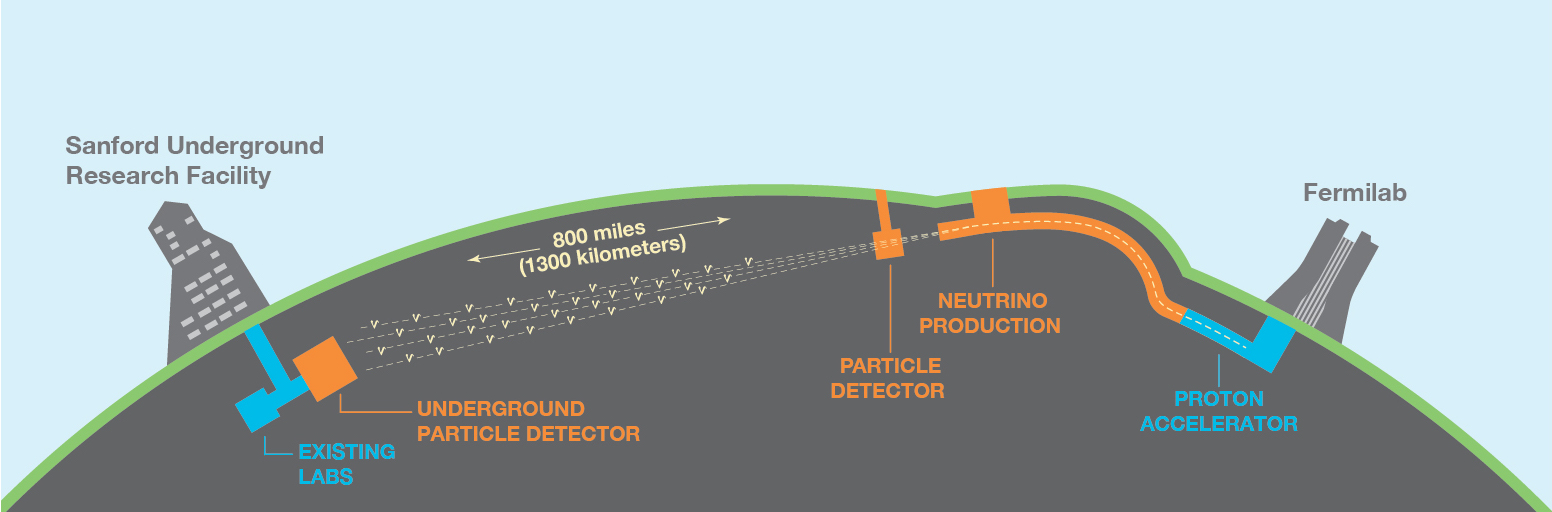
One of the most compelling projects underway at SURF is the Deep Underground Neutrino Experiment (DUNE), part of the Long-Baseline Neutrino Facility led by Fermilab and the U.S. Department of Energy.


In simple terms, DUNE is tackling one of science’s biggest questions: Why does the universe contain matter at all? Why aren’t we all just empty space?
A powerful beam of neutrinos generated near Chicago travels approximately 800 miles through the Earth to massive liquid-argon detectors at SURF. Neutrinos are among the most abundant particles in the universe. Tens of trillions from the sun pass through our bodies every second, yet they are famously shy. They almost never interact with ordinary matter, making them extremely difficult to study. The SURF detectors cannot simply catch them. Instead, they record the rare collisions inside liquid argon, capturing tiny flashes of energy and particle trails like an incredibly precise snapshot of each fleeting encounter.
This work continues a South Dakota legacy that spans more than half a century, from Ray Davis’s pioneering neutrino experiments in the 1960s to the massive DUNE far detector now taking shape. Generation after generation, South Dakota has quietly helped answer some of the most fundamental questions in physics.
Life Underground and Bioscience Connections
Beyond physics, SURF supports active biology research. Projects such as the Deep Mine Microbial Observatory study extremophiles. These are microorganisms that thrive in rock, water, and biofilms at depths where surface life could not persist. And that is what makes the environments like at SURF so special. They offer low-background, stable conditions valuable for certain life-science questions, including how life functions at its limits. The same distinctive underground setting that serves particle physics also serves as a real-world laboratory for microbial systems and extreme biology.
Engineering, Safety, and Human Systems
The operational reality is impressive. The facility functions like an inverted skyscraper where the infrastructure is built downward rather than upward. Air circulation, power, water management, and basic amenities all operate reliably underground. Safety culture is visible and rigorous, essential in an environment that combines industrial-scale operations with sensitive research.
International teams regularly commission and decommission experiments here; the collaboration itself — scientists and engineers from many countries working together on multi-decade infrastructure — demonstrates how relationships and shared facilities become the real architecture of progress.
SURF’s education and outreach programs extend this work outward, connecting K-12 students and the broader community with frontier science. The long view is explicit: investments made today are building the PhDs, engineers, and scientifically curious workforce of the coming decades.


A South Dakota Thread — E.O. Lawrence and the Spirit of Discovery
As I reentered the cage for the ride back to the surface, I thought of Ernest O. Lawrence, University of South Dakota alumnus, cyclotron inventor, Nobel laureate, and native of Canton, South Dakota.
What would he think of this world-class underground laboratory in his home state, pushing the frontiers of physics and biology?
The same restless, disciplined curiosity that carried him from a small prairie town to the center of 20th-century science is alive here. It is grounded in place, powered by partnership, and focused on the long game.

Bringing It Back to the USD Discovery District
This visit reinforced a core conviction in our work at the USD Discovery District. We cannot afford to lose sight of pure scientific curiosity. I believe the private industry will ultimately translate discoveries into applications that solve concrete problems. Our role includes nurturing the wonder, the “what if,” and the belief that South Dakotans can pursue ambitious goals even when they once seemed unlikely.
Early skepticism about building a research park in Sioux Falls has become motivation rather than discouragement. SURF stands as clear evidence that South Dakota can deliver on big visions when vision, partnership, persistence, and patient investment align.
We are not copying anyone else’s model. We are building what fits us.
We are building environments above and below ground where researchers, entrepreneurs, and institutions can do serious work, where curiosity is protected and cultivated, and where the next generation sees clear pathways to contribute.
My visit to SURF was one of the most memorable experiences I have had in South Dakota.
It left me more convinced than ever that our task is to steward that same spirit so the next curious student from a small town, or the next researcher seeking a distinctive testbed, finds a place ready for them.
You can read more about the event I attended here.