Home » Designing Systems That Scale: A Conversation with Marc Niamba
Designing Systems That Scale: A Conversation with Marc Niamba
Dr. Marc-Antoine Niamba discusses discipline, systems thinking, and building innovation infrastructure at USD Discovery District’s growing bioscience hub.
Innovation ecosystems often focus on startups, funding rounds, and breakthrough technologies. But behind every successful innovation economy is something less visible: infrastructure. The systems that connect researchers, entrepreneurs, investors, and institutions often determine whether new ideas move beyond the lab.
At USD Discovery District in Sioux Falls, Dr. Marc-Antoine Niamba, Director of Biotech Development, spends much of his time thinking about those systems — how they work, where they break down, and how they can be designed to scale.
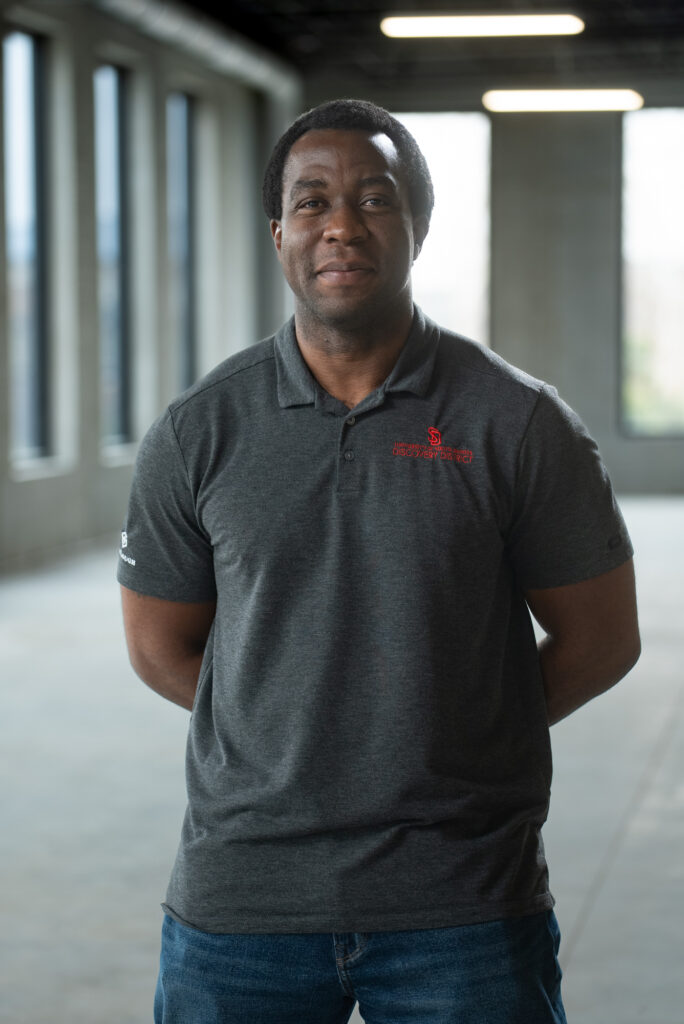
Niamba’s path to this work was anything but linear. As a child growing up in Côte d’Ivoire during the civil war, he was drafted into the military at the age of eight and remained there until he was eighteen. The experience shaped his understanding of discipline, responsibility, and systems that must function under pressure — perspectives that later influenced how he approaches innovation infrastructure and technology development.
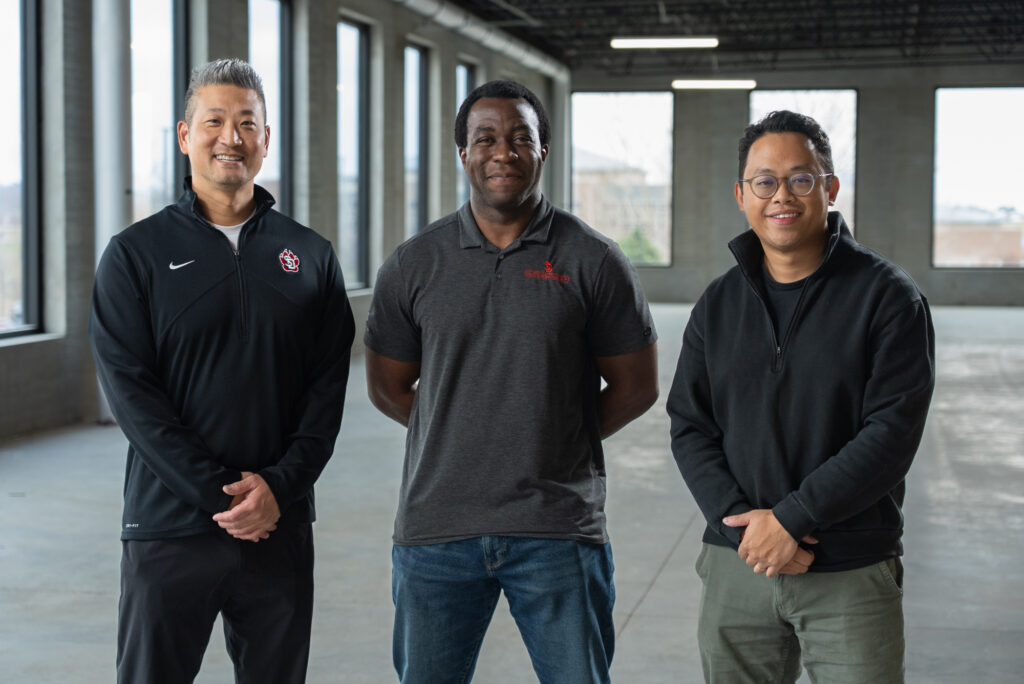
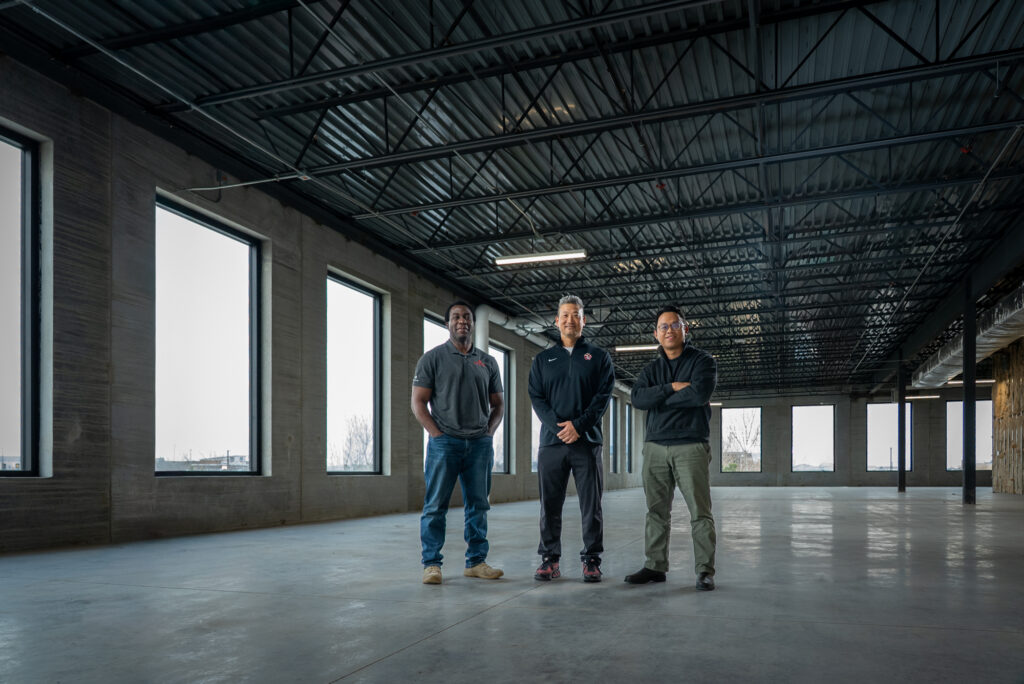
Marc (center) and team inside a core and shell space inside Building 1. Marc joined President Ryan Oines (left) and Tung Nguyen (Right) at the USD Discovery District in 2024.
Originally drawn to psychology because it seemed like the easiest academic path (his words), he nearly left university entirely to pursue boxing. Dr. Frank Schiever, his mentor and professor at the University of South Dakota, intervened, redirecting his curiosity toward research. This was the moment that ultimately set him on a trajectory spanning psychology, computer science, human factors engineering, and biotechnology development.
Niamba ultimately completed a rare interdisciplinary training at USD, earning a PhD in Human Factors and Applied Cognition alongside master’s degrees in Computer Science and Human Factors Psychology, an academic combination that now shapes how he approaches biotechnology development and the design of innovation systems.
Reflecting on the distance between the young man focused on fighting and the researcher he would become, Niamba puts it plainly:
“If that weird guy who was only thinking about fighting back then could make a 180-degree pivot and do these things now, then I’m pretty sure I can find a solution to whatever comes next.”
Dr. Marc-Antoine Niamba
Today, that interdisciplinary perspective shapes how he approaches one of the most persistent challenges in innovation: helping ideas move from research to real-world impact.
In this conversation, Niamba reflects on the disciplines that shaped his thinking, the importance of designing systems that work exactly as intended, and why improving access — not simply increasing investment — may be the most important factor in building sustainable innovation ecosystems.
Q&A With Marc Niamba
Q: Your academic background spans psychology, computer science, and human factors engineering. How did you arrive at such an interdisciplinary path?
Marc: It actually started in a pretty unplanned way. I chose psychology initially because it seemed like the easiest major. At that point in my life, I was more focused on boxing than academics, and I almost left university entirely to pursue that.
One of my professors intervened and encouraged me to stay and explore research. That moment changed my trajectory. I discovered that I really enjoyed investigating problems and trying to understand how systems work.
Later, I encountered computer science and programming, which opened an entirely new perspective for me.
Q: You’ve mentioned that learning programming changed how you think about systems. How so?
Marc: Programming forces you to think very precisely.
A program should do everything it is intended to do — nothing more and nothing less.
That discipline shaped how I approach problems more broadly. It taught me to think about how systems are designed, how they behave under different conditions, and how to make them function reliably.
When you combine that with psychology and human factors, you start to see how people interact with systems and where breakdowns occur.
Q: Much of your work now focuses on innovation infrastructure. What does that mean in practice?
Marc: Innovation infrastructure refers to the systems that support the movement of ideas from research into real-world applications.
In many universities, the incentives are structured around publishing research. That’s important, but it doesn’t always translate into commercialization or practical impact.
So the question becomes: how do we build systems that help researchers navigate that transition more effectively?
Q: You’re currently leading development of a coordination platform at USD Discovery District. What problem is it solving?
Marc: Many ecosystems rely on informal coordination such as email chains, introductions, and personal networks.
That works when the ecosystem is small, but it does not scale.
The platform we are building is designed to reduce that friction by organizing ecosystem resources in a structured way and helping people identify the right connections more quickly.
Q: You’ve spoken about designing systems that scale. What does scaling mean in this context?
Marc: People often think scaling simply means generating more revenue or expanding a platform.
But in many cases, scaling should mean improving access.
If you build something that works well, the goal shouldn’t be that only the people who can afford it get to use it. The goal should be expanding access to more people who can benefit from it.
That philosophy shapes how I think about innovation platforms and the systems we build around them.
Q: What motivates you to focus on these long-term structural challenges?
Marc: Part of it comes from my own path.
If someone had told me years ago, when I was paying my way through school with boxing, that I would end up working in biotechnology development and systems design, I probably wouldn’t have believed it.
But that experience also reminds me that people and systems can change.
If that version of me could pivot completely and find a new path, then I’m confident that most challenges we encounter can also be solved with the right approach.
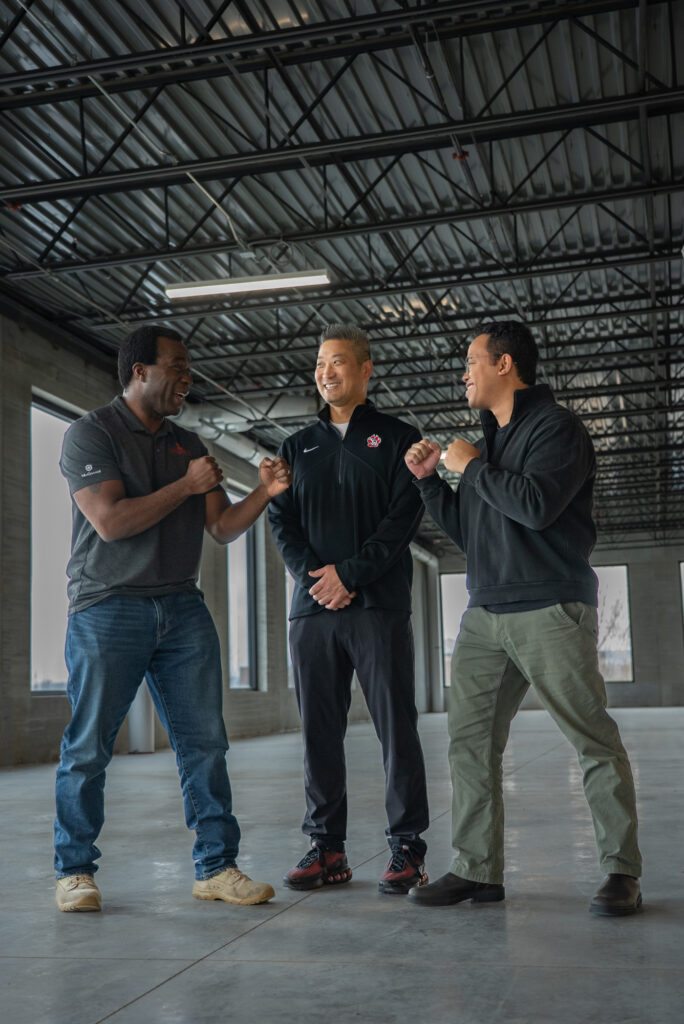
A light moment between teammates during the shoot.
Q: You’ve spoken about discipline rather than motivation. What do you mean by that?
Marc: I don’t rely on motivation. Motivation changes depending on how you feel that day.
Discipline is different. Discipline means your output is not dependent on your mood. You show up and do the work regardless.
A lot of people focus on trying to feel motivated. I focus on building habits and systems that make the work happen whether I feel like it or not.
Q: You’ve made significant sacrifices to pursue your education. Does that shape how you think about the work you do today?
Marc: Yes, absolutely. Education required sacrifices for me, and because of that I feel a responsibility to make it matter.
I don’t want knowledge to exist only inside papers or theories. I want it to translate into something useful — something that improves how systems function and how people interact with them.
If you are fortunate enough to gain access to education, you should use it to produce something relevant.
Q: Looking ahead, what would success look like for the work you’re doing now?
Marc: Ultimately, success would mean creating systems that help more researchers translate their ideas into real-world impact.
If we can establish structures that make it easier for students, scientists, and entrepreneurs to build companies and bring innovations to market, that creates long-term value for the ecosystem.
Rapid Fire with Marc
Before wrapping up, USD Discovery District President Ryan Oines submitted a few rapid-fire questions to reveal the human side of Marc. Systems thinker, disciplined builder, occasional buffet enthusiast — here’s a quick glimpse behind the philosophy.
Q: If you could speak to your younger self, what would you say?
Marc: I would tell him to join the military.
That experience taught me discipline very early. It taught me responsibility and resilience. Those lessons shaped how I approach everything I do today.
Q: What is the biggest challenge in your work today?
Marc: Aligning incentives across different parts of the innovation ecosystem. Everyone is trying to do good work, but the systems don’t always encourage the outcomes we want.
Q: What experience as an entrepreneur influences your work today?
Marc: Learning that ideas are only the beginning. Execution, persistence, and the ability to adapt matter much more than the initial concept.
Q: What is your leadership philosophy?
Marc: Build systems that allow people to do their best work. If the system is well designed, the outcomes usually follow.
Q: Two free things you never turn down?
Marc: Good food and good conversation.
Q: What are your long-term career goals?
Marc: I want to help build systems that make it easier for researchers and students to turn ideas into real companies.
Q: Be honest — what is the longest time you’ve ever spent at a buffet?
Marc: Long enough to make the buffet regret inviting me.
Q: Final question — is Burrito Juan your biggest nemesis in America so far?
Marc: Let’s just say it’s a formidable opponent.
What Marc is Building at USD Discovery District
Niamba’s work at USD Discovery District reflects a broader philosophy: innovation ecosystems do not succeed by accident. They succeed when the systems connecting research, talent, and industry are intentionally designed.
In South Dakota, he is working to build exactly that kind of infrastructure.